

What Is a Node Network? How Distributed Networks Are Rethinking Data Storage
Photos, documents, customer data, contracts, backups – digital data has become an increasingly important part of both our personal and professional lives. And most of the time, we simply trust that all of this data is stored somewhere safe.
But there’s a fundamental question worth asking:
What happens if that one place goes down – or comes under attack?
That’s where the idea of a Node Network gets interesting.
What exactly is a Node Network?
The term might sound technical at first, but the idea behind it is surprisingly simple.
Imagine you have an important document. Instead of keeping the entire document in a single filing cabinet, you use a system made up of multiple independent and secure storage locations.
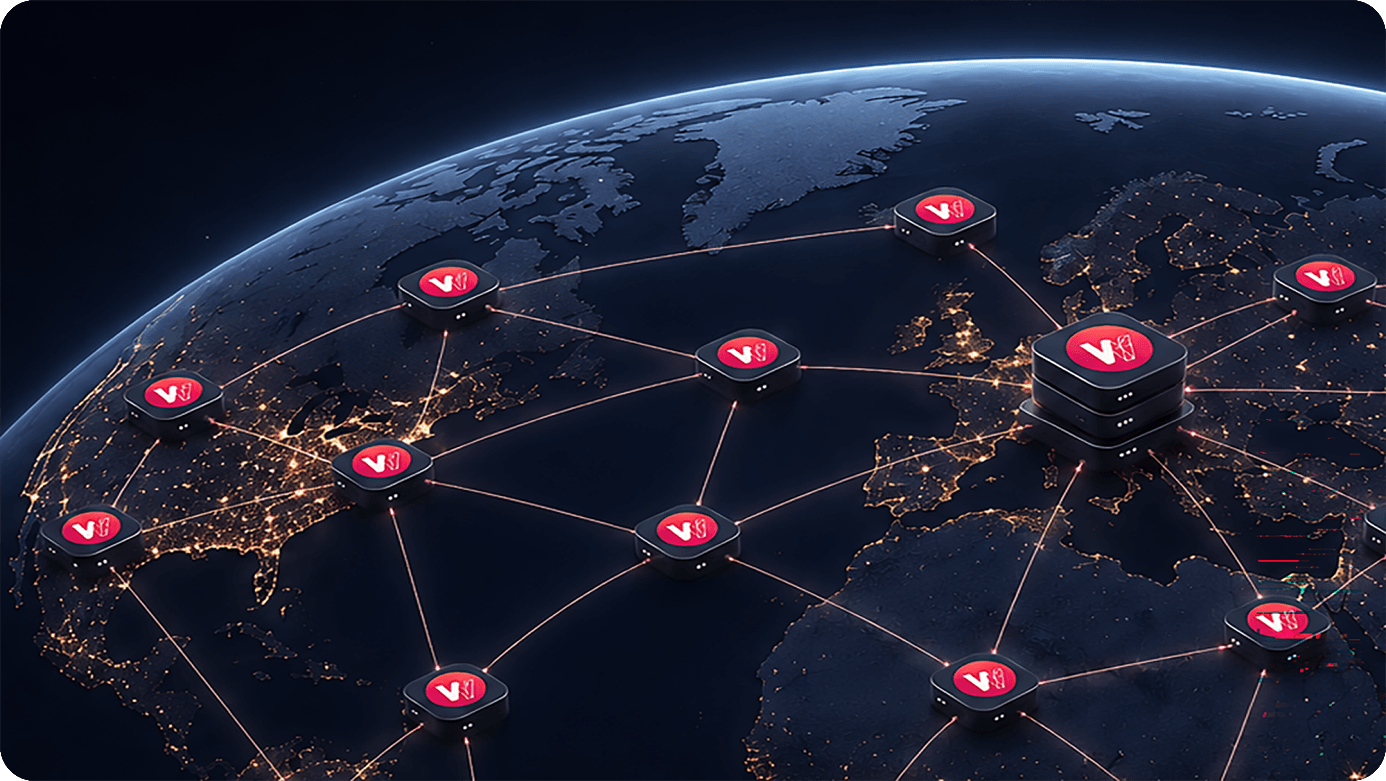
These individual points within the network are called nodes.
They work together to form a distributed network, meaning data no longer has to depend entirely on one central system.
The network itself becomes part of the security concept.
Why centralized storage can be a risk
Traditional IT infrastructures often work in a centralized way: data is stored on specific servers or within centrally managed data centers.
That can be practical and efficient. But it also creates a certain level of dependency.
If a critical part of that infrastructure fails, it can affect large numbers of users and significant amounts of data at the same time. Centralized systems can also be attractive targets for cyberattacks simply because there may be a lot to gain from compromising a single point.
A Node Network takes a different approach: not everything is stored in one place.
This is commonly referred to as a decentralized or distributed infrastructure.
Here’s a simple way to picture the difference.
Imagine two buildings.
In the first building, all valuables are stored behind one highly secured door. If someone manages to get through that door, they gain access to a very valuable target.
In the second building, those valuables are distributed across many separate, secured areas. Getting through a single door is no longer enough.
Benefit 1: Less dependency on a single system
One of the biggest advantages of a Node Network is the potential to reduce so-called single points of failure.
A single point of failure is a component whose failure could affect the entire system.
When functions and data are distributed across multiple nodes, the network can be designed so that other nodes remain available even if one of them goes offline.
For users, that means one important thing: greater resilience to technical issues and outages.
Benefit 2: Making things harder for attackers
Cybercriminals look for valuable targets. A centralized server containing large amounts of valuable data can be exactly that.
A distributed architecture changes the equation.
Depending on how the system is designed, data can be encrypted, split into separate parts and distributed across different nodes. As a result, a single node may not contain enough usable information to reconstruct the original data.
That’s an important distinction.
Even if an attacker manages to compromise one part of the infrastructure, it doesn’t necessarily mean they gain access to the complete data.

Benefit 3: Encryption protects the content
A Node Network alone doesn’t automatically make data secure. What matters is how the network is designed and implemented.
That’s why encryption is such an important part of modern data infrastructure.
Put simply, encryption transforms information into a format that is unreadable to unauthorized users. Only someone with the appropriate cryptographic keys can turn it back into usable information.
Think of it like a safe:
The safe itself can be in a known location. What matters is that only authorized people can open it.
In a well-designed Node Network, distribution and encryption can work together. Data is not only distributed across the network – its content is protected as well.
Benefit 4: Building a more resilient network
Hardware can fail. Internet connections can go down. Data centers can experience technical problems.
So the question shouldn’t only be:
“How do we prevent every possible failure?”
An equally important question is:
“How do we build a system that can handle failures when they happen?”
That’s one of the key strengths of distributed networks.
If data is stored redundantly or distributed in a way that allows it to be reconstructed from the remaining components, the system becomes less dependent on individual machines or locations.
This can improve both availability and resilience.
What does this mean for businesses?
For businesses, data has long become a critical asset. Customer data, contracts, development files, internal documents and backups don’t just need to be stored – they also need to be protected against unauthorized access, loss and outages.
Node Networks introduce an interesting additional approach.
Instead of relying exclusively on increasingly large centralized systems for security, infrastructure can be designed so that distribution itself becomes part of the security strategy.
- Encryption protects the content
- Distribution reduces centralized points of attack
- Redundancy helps protect against data loss and outages
It’s the combination of these principles that makes the concept particularly interesting.
WeSendit has built its own unique Node Network, making this type of distributed storage technology accessible to businesses and users.
There’s another important advantage: different storage options can be managed centrally through a single platform.
Businesses don’t have to remain permanently tied to a single storage provider. Instead, they can adapt their storage strategy as requirements change and choose between available providers and storage solutions directly within the WeSendit platform.
This allows WeSendit to combine the advantages of distributed infrastructure with the flexibility of established cloud storage solutions – giving businesses greater freedom when it comes to technology, provider and storage location.
Want to see all the benefits at a glance?
→ Explore WeSendit plans and features (opens in new tab)

The future of data security is distributed
Ultimately, this is about more than simply deciding where data is stored. It’s about how independently, securely and flexibly businesses can manage their data.
That’s where distributed storage architectures show their strength. Data no longer has to depend on a single server, location or system. Encryption, distribution and redundancy can work together to create an infrastructure that approaches security from a different perspective.
WeSendit takes this idea one step further by combining distributed technology with genuine choice. Businesses can decide whether to use the WeSendit Node Network or available cloud storage providers, choose the regions that meet their individual requirements, and manage their storage infrastructure centrally from a single platform.
Data security is no longer just about protecting data as effectively as possible. It’s also about reducing dependencies and maintaining control over where and how your data is stored.
This combination of security, distribution, control and flexibility creates the foundation for a modern, future-ready data infrastructure.
WeSendit Team
Editorial
The WeSendit editorial team keeps you up to date with the latest product news, security insights and stories from the world of Swiss file sharing.